Written byMorgane Egido Ledret, Created at 06/05/2026
3m
Table of contents
Oskar Fischinger is recognized as a pioneer of visual music, combining painting and animation in innovative ways. His work transforms abstract forms and colors into synchronized motion, creating a new visual language. This article explores his painterly origins and groundbreaking techniques. Discover how Oskar Fischinger visual music continues to influence motion graphics and contemporary animation.
Introduction: Oskar Fischinger and the Birth of Visual Music
Oskar Fischinger is recognized as one of the most influential figures in both painting and animation. His innovative approach tovisual music combined abstract painting techniques with synchronized animation. Creating a unique artistic language.
Before turning to filmmaking, Fischinger honed his skills as a painter, exploring geometric forms, color theory, and rhythmic composition. This foundation allowed him to translate the dynamics of music into moving images with precision and artistic depth. His short films transformed the possibilities of experimental animation while maintaining the compositional rigor of painting.
Today, Fischinger’s work remains a reference for artists, animators, and collectors interested in the intersection of visual art and motion graphics.
Fischinger began his career as a painter in Germany, developing a precise understanding of abstraction and color harmony. Influenced by Bauhaus, Expressionism, and Constructivism, he created canvases emphasizing geometric shapes and rhythmic color relationships.
These painterly experiments directly informed his early abstract short films, such as Studie No. 1 (1926) and Stimmung (1928), which synchronized motion and sound. Oskar fischinger visual music originated from this seamless integration of painting principles into animation. He also experimented with abstract light projections for performances, extending his painterly techniques into live, time-based visual experiences. These early works set the standard for pioneering abstract animation and remain a key influence for modern motion graphics and multimedia art.
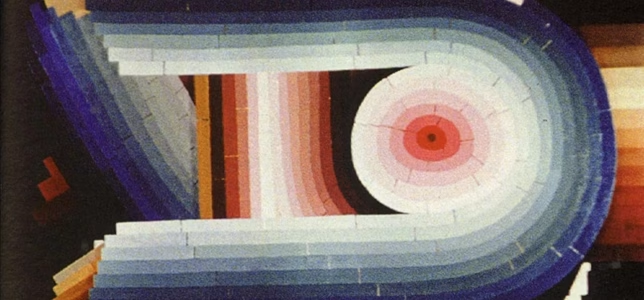
Central to Fischinger’s practice was the concept of visual music: translating musical structures into moving images. Oskar Fischinger visual music relied on meticulous synchronization between forms, colors, and musical rhythm. Techniques included painting directly onto film, stop-motion, and use of mechanical devices for precise timing. Motion Painting No. 1 (1947) exemplifies his painterly approach, showing evolving abstract shapes synchronized to Bach’s Brandenburg Concerto No. 3. His Lumigraph device projected abstract light compositions in real time, illustrating his interest in live visual music performance. These innovations established a methodology in which painting principles—composition, color theory, and rhythm—guide motion graphics.
Fischinger’s artistic and painterly background had a lasting influence on motion graphics, experimental films, and music videos. Animators like John Whitney and filmmakers in the 1960s cited his films as foundational references. His careful attention to composition, line, and color—skills honed as a painter—enabled him to create abstract animation with a visual musicality still referenced in digital motion graphics today. Oskar Fischinger’s visual music directly inspired the abstract sequences in Disney’s Fantasia (1940) and continues to inform contemporary experimental videos and interactive installations. Collectors interested in Fischinger’s work can observe the continuity between his paintings and animated experiments.
Fischinger’s legacy as both painter and filmmaker is preserved in institutions such as MoMA in New York and the Deutsches Filminstitut in Frankfurt. His contributions to experimental animation and visual music have been widely celebrated through retrospectives, exhibitions, and scholarly studies. Oskar Fischinger visual music is studied for its technical precision and artistic innovation. Fischinger’s approach to color, line, and rhythm continues to inspire animators, designers, and multimedia artists worldwide. Collecting his works allows audiences to engage directly with the foundations of visual music and experimental animation.
Oskar Fischinger’s career illustrates the profound link between painting and animation. Oskar Fischinger visual music demonstrates how abstract painting principles can inform motion graphics, music videos, and multimedia art. His meticulous compositional skills, mastery of color, and innovative use of rhythm continue to shape the practice of experimental animation. Fischinger’s legacy proves that innovation in visual media often stems from strong artistic foundations. Understanding his approach offers valuable insight into the evolution of visual music and its continuing impact on contemporary art.
Founded in 2013, Artsper is an online marketplace for contemporary art. Partnering with 1,800 professional art galleries around the world, it makes discovering and acquiring art accessible to all.