


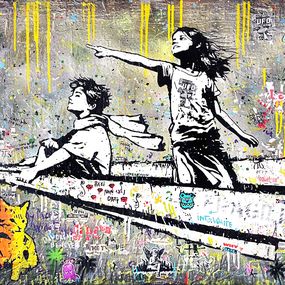




The 10 Most Famous Pieces of Street Art in the World
Illegal and ephemeral, street art was born in the 60s. Artsper reveals the 10 most famous street art works in the world!


Artsper’s best sellers
An authentic KAWS figure can sell for anywhere from $30 to $80 for a small Companion in an open edition, while large limited-edition vinyl figures can fetch more than $15,000. Between these extremes lies a diverse market, where prices are driven primarily by three factors: edition size, material and scale. Understanding this hierarchy is the first step before making a purchase.
The KAWS figure market can be viewed as a pyramid. At the entry level, open-edition vinyl figures such as Companion, Chum and BFF are produced in large quantities and originally sold for between $30 and $300. On the secondary market, they generally remain relatively accessible, often trading close to their original retail price. In the middle tier, numbered limited editions typically produced in runs of 500 to 3,000 pieces and associated with a specific event, exhibition, collaboration or special release can sell for anywhere from a few hundred to several thousand dollars. Prices vary depending on the figure’s size and the rarity of its colorway. At the top end, sculptures made from bronze, wood or fiberglass and produced in editions of just three to twenty-five pieces belong to an entirely different category. Prices can start in the tens of thousands of dollars and reach several million for the rarest works, such as At This Time (2016), an ebony sculpture produced in an edition of just three.

KAWS, Companion – Set of 6 – Sculpture in vinyl avaiblable on Artsper.com
Most KAWS figures on the market belong to the vinyl art toy category, produced with manufacturers such as Medicom Toy. These include open editions, which have no announced production limit but are released for a limited period, and limited editions, which are numbered and produced in a fixed quantity, often 500 or 1,000 pieces. The smaller the edition and the more closely it is tied to a specific context, such as a museum exhibition, a collaboration with a brand such as Dior or Uniqlo, or the launch of a monumental sculpture, the more likely the figure is to retain or increase its value on the secondary market.
At the rarer end of the market, KAWS has produced sculptures in very limited editions, generally between three and twenty-five pieces, in materials including bronze, wood and fiberglass. These works move beyond the realm of collectible toys and into sculpture proper, with some reaching more than two meters in height. Collaborations with popular franchises such as Star Wars, Disney and Sesame Street, as well as fashion houses, form another sought-after category. In these cases, the rarity of the collaboration can drive demand, sometimes regardless of the edition size.
KAWS’s popularity has made him one of the most frequently counterfeited artists in the art toy market, making authentication essential before any purchase. Several details can be checked without specialist expertise. The paintwork should be clean and consistent, with no bleeding or color misalignment. The character’s proportions should be accurate, with no visible molding defects. Figures typically feature markings underneath the foot or base, including the artist’s name, year, copyright information or manufacturer details. The original packaging should also match known editions in terms of format, typography and finish. Any supporting documentation, such as the original invoice, certificate of authenticity or sales history, can further strengthen confidence in the piece.
The most heavily copied figures are often the most sought-after. Companions from the OriginalFake period, KAWS’s Tokyo store opened in 2006, and large limited-edition figures account for a significant share of counterfeits. Warning signs include uneven paintwork, an unusually light weight, dimensions that do not precisely match official references, or a colorway that does not correspond to any known release. A price significantly below the lower end of the market range for a particular size and edition should also raise concerns: authentic pieces rarely sell substantially below their established market floor.
Before purchasing a KAWS figure, a few simple precautions can significantly reduce the risk of buying a counterfeit. Prioritize established sellers and platforms that verify the provenance of artworks rather than open marketplaces, where counterfeit goods are more common. Always ask for proof of provenance, such as an invoice or certificate of authenticity, and compare the asking price with the actual market range for the specific size and edition. It is also important to distinguish between accessible collectible toys and limited-edition sculptures, as they follow very different valuation dynamics.
On Artsper, every artwork offered for sale undergoes an authenticity check before being listed, while the marketplace also provides a return policy, offering two useful safeguards in a market where careful due diligence remains essential.

Illegal and ephemeral, street art was born in the 60s. Artsper reveals the 10 most famous street art works in the world!

Explore the evolution of abstract sculpture, from its early pioneers to contemporary artists. Discover how this art form redefined shapes, materials, and space, influencing modern art movements worldwide.

Although less favorable than the almighty painting or installation, sculpture is still widely explored by contemporary artists. We bring you the 10 contemporary sculptors you should know.

KAWS is one of the most creative voices of our time. He is a multidisciplinary artist who goes beyond the traditional definition of art, to speak a universal language.

This artist is shaking up the art world by giving free rein to his creativity on different media. Discover 5 things to know about Kaws!

Humourous, captivating, disturbing and heavily engaged urban frescoes adorn the walls of cities worldwide. However, with street art's increasing presence in galleries, many believe that the street-art is “domesticating” itself, and is losing its urban identity. Artsper takes to the streets to find the 10 street artists you simply must know.
Founded in 2013, Artsper is an online marketplace for contemporary art. Partnering with 1,800 professional art galleries around the world, it makes discovering and acquiring art accessible to all.
Learn more