


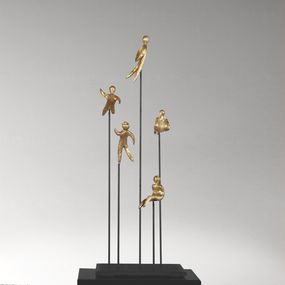


Contemporary Assemblage - The Art of Found Objects
Assemblage art combines found objects into new creations, mixing sculpture and collage in contemporary artistic expression.


Artsper’s best sellers
A vast terrain of Mormon Mesa between the Virgin River and the Muddy River in Nevada was planned to become the site of an ambitious Battle Born Solar Project intended to push forward renewable energy across the US. Although promising at first glance, the project was abandoned following backlash from locals and art aficionados of Michael Heizer’s Double Negative situated in this area.
According to the members of the resistance group called Save Messa, this particular solar farm that should have been the largest in the country would endanger local wildlife, and agricultural economies, desecrate the ancient lands of American Indians and forever change the undisturbed landscape, including Heizer’s earthwork.
An artwork that one of the best-known Land artists named Double Negative, is an actual trench created in the earth by the removal of more than 200,000 tons of rock. The intervention 30 feet wide, 50 feet deep, and 1500 feet long, comprises two sides of a natural canyon into which the excavated material was thrown, and the title of the work refers to a gap, e.g., “negative space” that is both natural and artificial.
In 1969, a successful art dealer Virginia Dwan purchased a 60-acre site in the Moapa Valley on Mormon Mesa near Overton in Nevada for Heizer’s work, and two years later, the artist urged the Dwan Gallery not to sell it. Almost a decade later, in 1984, in agreement with Heizer, the art dealer decided to bequeath Double Negative to the Museum of Contemporary Art, Los Angeles. One of the items in the contract highlighted that MoCA should not conduct the conservation of the piece as the artist noted that nature should take over his intervention through weather conditions and erosion.
Nowadays, four decades later, many perceive Double Negative almost as a geological curiosity naturally formed throughout time. What makes it man-made is the apparent symmetry of its matching sides reminiscent of the architectural structures, for instance, ancient burial sites, cathedrals, or even the Minimal artworks typical for the era.
At first glance, it is just a pit in a dry terrain covered by send and saturated with stone. Nevertheless, it is definitely more than that. Michael Heizer himself has nicely described the work by simply saying that “there is nothing there, yet it is still a sculpture.” This particular statement of his brings us closer to the very nature of Land art, a movement that emerged as its proponents critically responded to the evolving art market and overall commodification of art in the 1970s.
Double Negative is one of Heizer’s first earthworks based on working outside the studio in an open space with natural materials such as earth, stone, wood, etc. These radical projects took more time, people, and machinery and were conceived with the natural environment and shifting conditions. Alongside the iconic Spiral Jetty by Robert Smithson or Nancy Holt’s Sun Tunnels, this work by Michael Heizer also provokes the observer to think of the earth as art. Furthermore, by disrupting the untouched landscape framed by the sound of the wind and the warmth of the heat, the artist creates a space for contemplation that has a life of its own. The impermanence of Double Negative allows us to pose radical questions novel at the time concerning how we approach and experience an artwork.
The artist’s solo exhibition In Context: Michael Heizer, Geometric Extraction, organized by MoCA in 1984, included a photograph of Double Negative. However, the comprehensive survey of land art Ends of the Earth organized by the same museum in 2012 did not include any documentation of the work except in the catalog. Heizer declined for Double Negative to be represented as he believed that any photographs in an exhibition space would misrepresent a sculpture that requires physical experience.
The astounding sculptural intervention engaged with scale and wideness of the space is located in a remote area of Mormon Mesa, relatively far from Las Vegas, and requires a vehicle with good tires due to rocky road. Its vastness overwhelms anybody approaching it. A solar farm would eternally alter the perception of Double Negative.
Another more elaborate work by Michael Heizer, The City, demands the same focus and cession. This site, marked by almost mythological allure, took forty years to finish. After its completion, it sparked controversy for being erected on the ancestral territories of the Southern Paiute and Western Shoshoni people. Although the artist and the Triple Aught Foundation in charge of the work acknowledged this fact, a few Indigenous artists and scholars have noted that this is just another manifestation of historic settler colonialism. This criticism can be applied to works by other artists such as Robert Smithson and Walter de Maria since many movement practitioners approached land as property in capitalist terms.
Nevertheless, thanks to the loud voices of Heizer fans, conservations, and local residents, Double Negative and the surrounding landscape are safe since the Battle Born Solar Project was never realized. However, it seems a bit ironic that a renewable energy project, which is typically seen as a positive step towards addressing climate change, was opposed due to the concerns about the impact on the environment and cultural heritage. Balancing the need for renewable energy with protecting the environment and cultural heritage is a complex issue, and there are often trade-offs and compromises that need to be made.

Assemblage art combines found objects into new creations, mixing sculpture and collage in contemporary artistic expression.

Explore the evolution of installation art through famous artists: immersive, sensory-driven experiences that redefine modern creativity.

Artists across the globe are making a significant impact by raising awareness about the challenges hindering sustainable development. Discover these impactful artists with Artsper!

Discover the environmental art being created by activist artists who wish to raise awareness of the climate emergency through their works.

Today, Artsper analyses with you one of the most emblematic works of Land Art, Spiral Jetty by Robert Smithson.

Land Art is the name of an art movement which uses the environment as a canvas for art. Here are several amazing and surprising works that will blow your mind!

Founded in 2013, Artsper is an online marketplace for contemporary art. Partnering with 1,800 professional art galleries around the world, it makes discovering and acquiring art accessible to all.
Learn more