


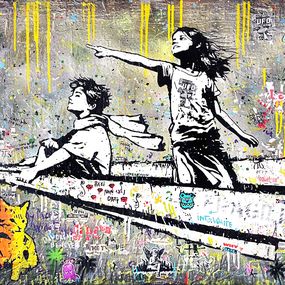




10 Things to Know About... JR
JR is a contemporary photographer and street artist. His specialty? Monumental works!


Artsper’s best sellers
The Cave of the Pont Neuf, the monumental installation by JR, has had its opening postponed. The project remains extraordinary in scale: a 120 meter cave that covers the oldest bridge in Paris, forty years after the wrapping project conceived by Christo and Jeanne Claude.
Two years of work and 800 people involved: arches, parapets, and structural elements disappear under vast images of limestone blocks. From a distance, the bridge no longer looks like an engineering structure but like a rocky cliff face.
Pont Neuf is the oldest bridge in Paris.
JR is known for large scale interventions in public space, using giant portrait collages placed in highly visible locations such as the Louvre Pyramid or buildings in Montmartre. With The Cave of the Pont Neuf, he applies the same approach to the Pont Neuf, covering it with images to completely transform its appearance.

The gesture of JR is part of a now clearly identified practice: working at a monumental scale to transform the perception of places. Here, however, the logic of covering does not only produce a visual metamorphosis, it also creates a sense of disruption.
What is shown is not an intervention on the actual material of the bridge, but an image of its supposed material. Limestone becomes photography, and stone becomes representation. The monument is not revealed; it is replaced by its double.
One could see this as a celebration of the geological and architectural history of Paris. It can also be read as a form of shift: a heritage that is now experienced through its own image.

JR, La Caverne du Pont Neuf, 2026
The project explicitly engages in a dialogue with The Pont Neuf Wrapped by Christo and Jeanne Claude in 1985, when the bridge was entirely wrapped in fabric. Where Christo and Jeanne Claude’s work transformed the physical presence of the monument, JR introduces a more ambiguous shift: the structure is preserved, but its reading is disrupted.
Forty years later, the gesture is no longer one of veiling, but of visual substitution. The bridge is no longer hidden; it is redefined through imagery.

Christo et Jeanne-Claude, The Pont Neuf Wrapped – XXL Dibond Edition, 1985 – Photography available on Artsper.com
The opening of The Cave of the Pont Neuf, scheduled for June 6, has been postponed after strong gusts of wind damaged the outer fabric in early June, while the work was still in progress. Part of the covering was torn in several places, and the damaged fragments were sent for repair to the Breton workshops where they had originally been produced.

JR, The Cave of the Pont Neuf, 2024, collage. Courtesy Atelier JR © 2024 JR
As a result, the bridge now presents a hybrid appearance. At both ends, the fabric has been removed, revealing the bare inflatable structure in a uniform white. In the center, only part of the work still retains its trompe l’oeil rocky appearance. The image JR had constructed to cover the bridge is thus fading in places, inadvertently revealing the backstage elements: the technical structure that is usually hidden beneath the illusion.
Once the fabric has been repaired and reinstalled, visitors will be able to discover a route designed as a complete experience: a sound installation by Thomas Bangalter (Daft Punk), along with olfactory effects and augmented reality elements, will complement what is visible, shaping the way the space is perceived.
The Cave of the Pont Neuf raises a simple but central question: are we still looking at a monument, or at the version constructed by its image?
The bridge is not truly transformed in its structure, but in how it is perceived. Covered with photographic representations of stone and integrated into a sound and immersive system, it becomes less an architectural object than a framed visual experience.
This idea is not new in art history. It can be found, for example, in the work of artists such as René Magritte, who already showed that the image is never the thing itself, but a representation capable of shifting its meaning. Here, the Pont Neuf operates in a similar way: what we see is not the bridge, but an image of the bridge.
In a city already saturated with representations, JR does not simply cover the Pont Neuf. He adds another layer of imagery to a site already heavily charged with meaning. The monument becomes simultaneously support, subject, and projection surface.
The bridge is still physically present. But the experience of it now passes through a set of visual, sonic, and narrative filters that strongly guide perception.
Ultimately, the question is perhaps not only what we are looking at, but to what extent that gaze remains free.

JR, La Caverne du Pont Neuf, 2026
Once the installation has disappeared, the Pont Neuf returns to its original appearance. Yet the work leaves a more lasting trace: that of a gaze that has become accustomed to being guided.
Between image and reality, The Cave of the Pont Neuf questions the space left to the viewer within a fully constructed experience.

JR is a contemporary photographer and street artist. His specialty? Monumental works!

Calling all street art lovers with an appetite for exploring! Check the top places to discover street art in Paris and get searching!

Like art, revolutions begin in the streets, where the urban backdrop provided the means to unite individuals and voice their desires for change.

Explore the evolution of installation art through famous artists: immersive, sensory-driven experiences that redefine modern creativity.
JR is a contemporary photographer and street artist. His specialty? Monumental works!

Explore the meaning, origins, and impact of installation art. Learn how immersive art installations transform spaces and engage the senses.
Like art, revolutions begin in the streets, where the urban backdrop provided the means to unite individuals and voice their desires for change.

How about seeing the big picture! Monumental art, even an extraordinary one, here’s the spectacle offered by the public works, booming in our cities and countrysides. Artsper has returned to the creations of 2016, which has been amusing us for the past few months, followed by a foretaste of the ones, awaiting us in 2017. Public sculptures or installations are…

Founded in 2013, Artsper is an online marketplace for contemporary art. Partnering with 1,800 professional art galleries around the world, it makes discovering and acquiring art accessible to all.
Learn more