


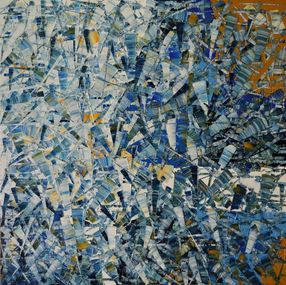


10 Artists Who Explore Geometric Abstraction
Geometric abstraction evolved from the Cubist destruction of form and space. Here are 10 artists who explored this genre.


Artsper’s best sellers
Victor Vasarely, the father of optical art, transformed simple geometric shapes into fascinating visual experiences filled with illusions and colors. A painter of the second half of the 20th century, his creations not only left their mark on art history but also continue to influence contemporary design. Explore how Vasarely transformed visual art and his lasting impact on contemporary design.
Born in Hungary in 1906, Győző Vásárhelyi (who became Victor Vasarely in 1961 when he obtained French nationality) began studying medicine after graduating from high school but dropped out after two years. In 1929, he enrolled at the Mühely Academy, the Bauhaus of Budapest, and then at the Beaux-Arts. These studies instilled in him the importance of functionalism and opened the doors to abstract art. There, he refined his graphic design skills and deepened his mastery of trompe-l’œil.
His artistic education was influenced by the Bauhaus, constructivism, and surrealism movements.
With his wife, he left Hungary and settled in Arcueil, France, in 1930. Vasarely then began to make a name for himself in graphic design. He worked for advertising agencies such as Havas, for which he created his famous Zebras in 1937. Influenced by his Bauhaus education, Vasarely wanted to make art accessible and functional by integrating it into design.

During his graphic period (1929-1946), Vasarely’s visual identity was distinguished by his work with lines, the interplay of light and shadow, textural effects, and his interest in perspective.
Although the artist’s creations were figurative at the beginning of his career, in 1947 he had a revelation about abstract art. He said: “I only had a true revelation of abstraction in 1947, when I suddenly recognized that pure form and pure color can signify the world.” It was this realization that marked the beginning of his transition to abstraction, strongly influenced by the masters of the time, such as Wassily Kandinsky, Piet Mondrian, and Paul Klee.
Vasarely’s works from the Belle-Isle period are considered to be the first of his abstract approach. Anecdotal evidence suggests that the ellipsoidal shapes he painted were inspired by the pebbles on the beach at Belle-Île-en-Mer in Brittany.

After 1947, Vasarely produced his first geometric works. In addition to the shapes he used, he created color contrasts to generate optical illusions. This work marked the beginning of his research into visual perception, particularly the use of color and simple geometric shapes (squares, circles, triangles) to create illusions of depth and movement. He thus became a pioneer in the manipulation of shapes to deceive the human eye.
His education at the Bauhaus played a crucial role in Vasarely’s artistic approach, teaching him the importance of the interaction between geometric shapes and functional principles. He used mathematics, geometry, and the sciences of perception to create works that went beyond simple abstraction and aimed to deceive the eye and awaken sensory reactions in the viewer.
Vasarely also drew on the work of Ewald Hering, a psychologist and physiologist who studied color perception, to create works in which vibrant contrasts seem to make shapes move or distort, a technique that became a central feature of Op Art.
1948, he took a trip to Gordes, in the south of France. He was accompanied by other artists from the gallery where he exhibited his work (La Galerie Denise René). Gordes was a key location in Vasarely’s artistic career. He observed the effects of sunlight and shadow on visual perception, which inspired him to create optical illusions.

The term “Op Art” appeared between the 1950s and 1960s. It refers to a pictorial art form that exploits the characteristics of the eye and optical illusions to create a sensation of movement or luminous vibration. Vasarely’s works, such as his famous silkscreen prints, were at the forefront of this movement, giving rise to a completely new genre.
The techniques used by Op Art artists include color contrasts, geometric shapes, lines, repetitions and patterns, overlays and transparencies, and symmetry and asymmetry.

The aim of Op Art is to create movement without actually moving the lines, which distinguishes it from kinetic art. Kinetic art, which emerged in the 1950s, is characterized by the use of moving mechanisms, lights, and installations that generate movement. Alexander Calder and Jean Tinguely are considered leading figures in kinetic art.
Vasarely’s art also extends to sculpture and the creation of installations that give the illusion of movement through the use of perspective and special materials.

At the dawn of the 1960s, Vasarely developed a plastic alphabet. This alphabet served as a tool for creating and organizing his works according to the principles of Op Art. It consisted of 30 basic geometric shapes (squares, circles, triangles, etc.) associated with 30 colors. It was a systematic method for creating coherent visual compositions based on mathematical and perceptual principles. Thus, his works owed nothing to chance. The artist patented it in 1959.

The optical art movement reached its peak with the exhibition “The Responsive Eye” at MoMA in 1965. This exhibition, which highlighted Op Art artists, presented Vasarely’s works alongside those of other pioneering artists such as Bridget Riley and Jesús-Rafael Soto. Op Art thus became a recognized discipline and popularized optical illusions. Vasarely then achieved the status of leader of the movement and influenced artists internationally.

Between 1960 and 1970, Vasarely produced no fewer than a hundred works. He began to focus on the use of screen printing, which allowed him to reproduce his complex geometric patterns while maintaining the integrity of the visual optical effect. This technique enabled him to produce numerous works in series and thus broaden his audience.
In the 1960s and 1970s, Vasarely’s influence was everywhere. His works could be seen on the streets, in museums, in offices, and even in our own homes.
Victor Vasarely’s work is not limited to creations intended for display in galleries or salons. Seeking to democratize his art, the artist undertook several architectural integration projects. Parisians reading this article are surely aware that we owe the frescoes at Montparnasse station to the father of optical art.

Op art found its way onto wallpaper, carpets, lamps, and posters in homes in the 1960s and 1970s. The interior of the BundesBank (German Central Bank) headquarters in Frankfurt was decorated by Vasarely in 1972. He created a series of monumental works that were integrated into the structure of the building.

Moreover, together with his son Yvaral, they designed the logo for the Renault car brand in 1972. Graphic designers of the time increasingly drew inspiration from the artist’s visual signature.

For example, the Vasarely effect can be seen on the cover of David Bowie’s album Space Oddity, which was largely inspired by the work CTA-25-BC.

The Vasarely phenomenon also extends to fashion and textiles. For his spring/summer 2022 collection, fashion designer Julien Dossena, then artistic director at Paco Rabanne, organized a fashion show inspired by optical art. The venue chosen was emblematic: the rooftop swimming pool of the Monaco Convention Center, designed by Vasarely for Prince Rainier in 1979. The models on the runway wore true works of art bearing the mark of the father of optical art.

“I am not in favor of private ownership of creations. I don’t care if my work is reproduced on miles of dishcloths! Art must be created in a way that can be multiplied.” Victor Vasarely
Vasarely’s work also foreshadowed the digital age, particularly in the design of modern interfaces. His use of geometric shapes and optical illusions inspired interface designers to explore visual and dynamic interactions in early computer graphical interfaces and video games.
A striking example is the video game Tetris, launched in 1984. The influence of optical art is evident, particularly in the design of the blocks. The simple, geometric shapes that stack up on the screen, creating an effect of constant movement and depth, are reminiscent of Vasarely’s style.

In 1971, Victor Vasarely founded his foundation in Aix-en-Provence. Inaugurated in 1976, it has been classified as a Historic Monument since 2013 and has been awarded the “Musée de France” label since 2020. This architectural center, designed as a total work of art, incorporates 44 monumental works by Vasarely into its structure, offering a total immersion into the world of Op Art.

The Foundation is a must-see if you are staying in Aix-en-Provence and want to learn more about this genius of optics.

Victor Vasarely left his mark on art history with his visionary approach to the use of geometric shapes and colors. Founding father of optical art, he left a lasting mark by reshaping aesthetics and democratizing art. By making art accessible, he shaped a new visual style that still inspires today. Explore Victor Vasarely’s world through books, museums, and exhibitions celebrating his life and work.

Victor Vasarely was a Hungarian artist who became a naturalized French citizen and is considered the father of optical art (Op Art). He revolutionized abstract art by using geometric shapes and optical illusions to create fascinating visual works.
Op Art is an artistic movement that uses optical illusions to trick the eye, creating a sensation of movement or light vibration. Vasarely was one of the pioneers of this movement, with works such as Vega and Ispahan.
Vasarely had a profound influence on graphic design, architecture, and interior design with his geometric patterns and optical illusions. His style can be seen in logos, advertisements, and even modern video games.
Many of Vasarely’s works are on display at the Vasarely Foundation in Aix-en-Provence, and his creations can be seen in museums such as the Centre Georges Pompidou in Paris and exhibitions around the world.
Vasarely’s plastic alphabet is a system based on 30 basic geometric shapes that he created to organize his works. This system was patented in 1959 and allows for the creation of coherent and organized visual compositions.
Yes, Vasarely incorporated his art into famous architectural projects, such as the murals at Montparnasse Station in Paris and the interior design of the BundesBank headquarters in Germany. He also designed the exterior of the building housing his Foundation in Aix-en-Provence.

Geometric abstraction evolved from the Cubist destruction of form and space. Here are 10 artists who explored this genre.

Trompe l’oeil, meaning “to deceive the eye,” is an art technique using illusionistic realism to create 3D effects—revealing our fascination with hidden truths.

The American artist Alexander Calder redefined the boundaries of sculpture, transforming it from a static art form into a dynamic interplay of movement, volume, and vibrant color. Today Artsper brings you to discover his 5 most famous mobiles.

From February to May, discover Vasarely's work at the Centre Pompidou. Artsper flies you to the moon for an odyssey in the heart of the 60s Space Age.

This week the Fashion Week is in full swing! This is the opportunity for Artsper to talk again about the connection between the world of contemporary art and that of great fashion designers. Connections that encourage innovation, but can sometimes lead to confusion and debate... A History of Collaborations On the left, the pop-up store and the products from the…

From humble beginnings to an art form, discover how furniture became what it is today and the artists who merged these creative crafts...

Founded in 2013, Artsper is an online marketplace for contemporary art. Partnering with 1,800 professional art galleries around the world, it makes discovering and acquiring art accessible to all.
Learn more